This past week, I met with some business leaders who are strong in their faith, grounded in Scripture, and successful in their careers. I was curious how they view their success in light of faith and Scripture. Why? Because I don’t always see those three attributes—faith, Scripture, and success—synchronizing well in people’s lives.
I often ask people who have come through deep pain how they handled their pain. How do people cope with failure, loss, struggle, or grief?
The question I don’t ask nearly as often is related to the opposite end of the failure-success spectrum. How do Christ followers handle success? Just as someone who has experienced significant loss can become overwhelmed by it, the same can be true of someone who has experienced significant gain.
Didn’t Jesus warn us that “it is hard for someone who is rich to enter the kingdom of heaven” (Matthew 19:23)? The implication is that there is just as much of a temptation to get off track spiritually through riches as there is through poverty. Through poverty, we can feel abandoned by God. Through riches, we can feel we don’t need God.
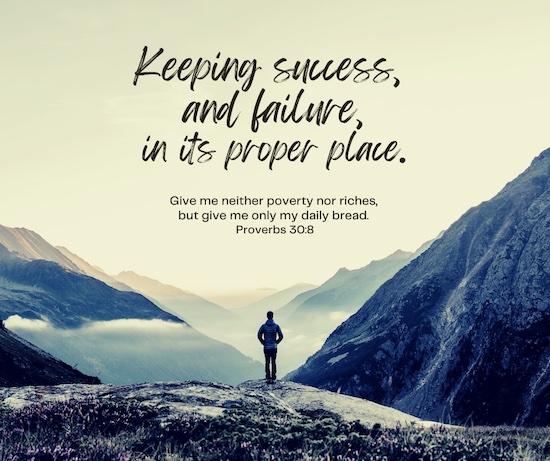
The wisdom of Solomon teaches us, “Give me neither poverty nor riches, but give me only my daily bread. Otherwise, I may have too much and disown you and say, ‘Who is the Lord?’ Or I may become poor and steal and so dishonor the name of my God” (Proverbs 30:8-9).
The Apostle Paul told Timothy to “Command those who are rich in this present world not to be arrogant nor to put their hope in wealth” (1 Timothy 6:17).
So, I asked these business leaders, “How do you cope with your success? How do you remain reliant on God and faithful to the Gospel?”
Their responses were very similar. At the core, they told me, is the importance of keeping the main thing the main thing. The main thing in the Christian life is not to gain the rewards of earth but of heaven. The main thing is to see earthly gain as a tool for God’s Kingdom purposes.
Each of them sees his business as a gift from God, ultimately to honor God, lift up Jesus, and serve others. They pray they will be a witness to the higher calling of living out Kingdom values in how they treat their employees, make decisions, and run their companies.
Their wise counsel made me ask myself those key questions: How do I handle failure? And how do I handle success? If I see my role in this life as knowing Jesus and making Him known, then I can keep my focus on “things above and not on earthly things” (Colossians 3:2).
And what difference does this make in our day-to-day lives? Quite a bit, actually. Do you wring your hands and plunge into the pit of despair depending on whose political party is in power? Do your emotions fluctuate with the volatility of the stock market? Is your mind focused on what YOU will gain and what YOU could do if only you had just a little bit more money?
I want to challenge you this week to re-evaluate where you are placing your hope. I already quoted Paul’s words in 1 Timothy 6:17, but Paul goes on to say we are not to put our hope in wealth, “which is so uncertain, but … in God, who richly provides us with everything for our enjoyment.” We are commanded to do good, to be rich in good deeds, and to be generous and willing to share. (1 Timothy 6:17-18).
In other words, let’s put our successes … and failures in their proper place. They don’t define us nor control us. They simply are. They exist for God’s glory and for His Kingdom. And so, we can say with Paul, yet again, “I know what it is to be in need, and I know what it is to have plenty. I have learned the secret of being content in any and every situation, whether well fed or hungry, whether living in plenty or in want. I can do all this through him who gives me strength” (Philippians 4:12-13). Soli Deo gloria. Amen.